

Part 1 introduced Markov games, and Part 2 studied shared-reward credit assignment under full observation. We now let agents receive different observations. Centralized training with decentralized execution (CTDE) uses joint information for training but restricts each deployed actor to its own information. We examine which centralized critics preserve the local actor's gradient and why a critic using only the physical state can discard relevant information from the actor's history.
Recap: The conditional-expectation identity behind a critic
The policy-gradient calculation weights a return by an actor's score. If the information determines that score , the tower property gives
Both expectations use the same fixed-policy trajectory distribution. The identity lets us replace the return by its conditional mean without changing the expected gradient. The critic's information must retain everything needed to determine the score; otherwise this argument does not apply.
1. Specify what each agent knows
Consider cooperative agents and a finite horizon . States , actions , observations , and shared rewards take values in finite sets. Rewards are bounded and . Write and similarly . The environment has a latent controlled Markov state:
The joint observation kernel may correlate agents' observations. No conditional independence of observations is assumed. This is a finite-horizon decentralized partially observable Markov decision process (Dec-POMDP), using a joint kernel to include observed rewards. Compare Oliehoek, Spaan and Vlassis, Section 2.1.
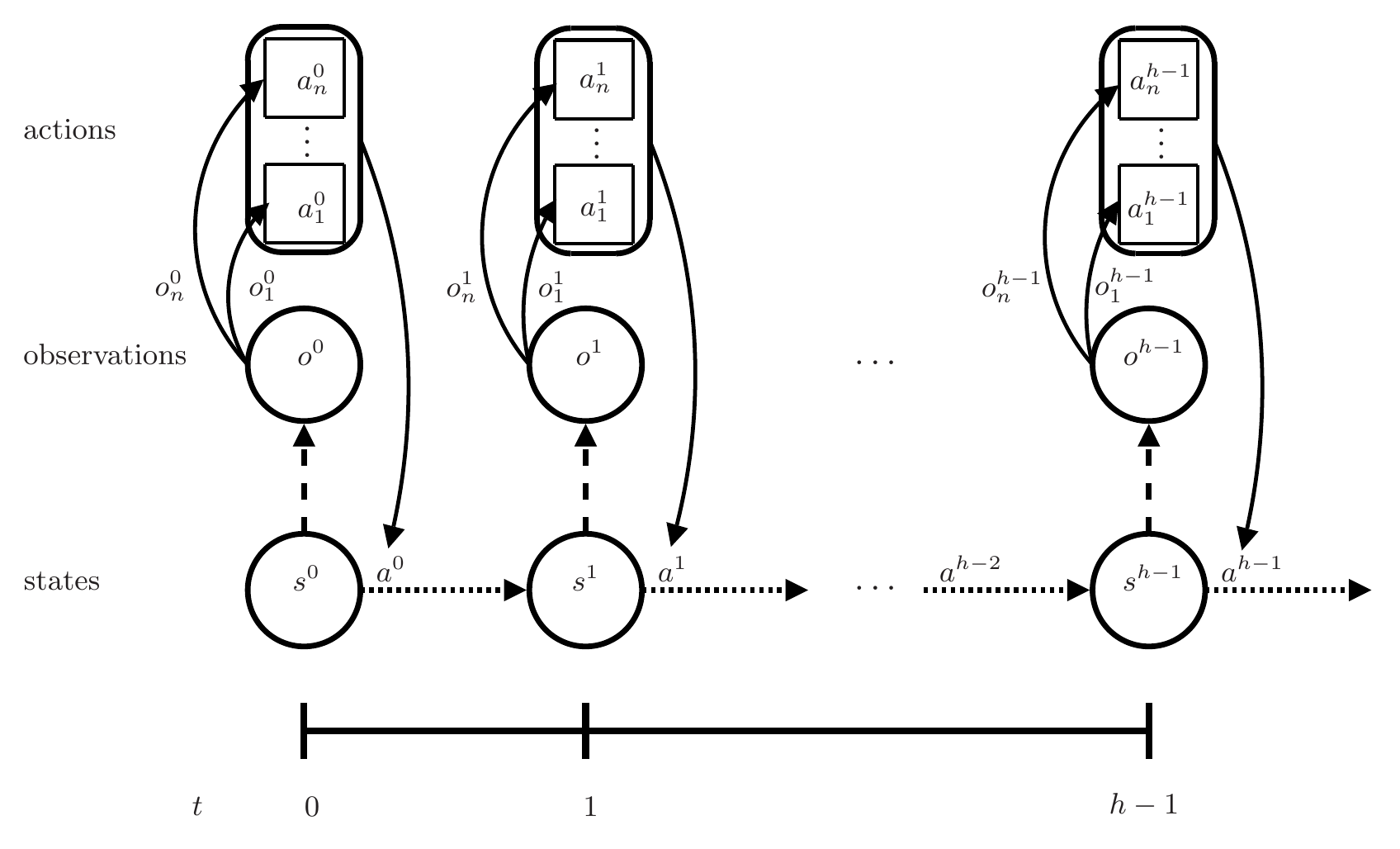
In our convention every agent observes the shared reward after each action. Before choosing , agent has local history
It does not automatically observe teammates' actions, observations, or the state. The joint history available to the trainer is
Each is a projection of . A decentralized policy with independent private randomization satisfies
Here is the local projection of and is fixed during execution. Training may estimate using every agent's data; the runtime policy still receives only . Sharing trained parameters does not share current observations. Messages, if allowed, must be explicitly included in the receiving agent's history.
Let be the trajectory distribution generated by the initial law, these product policies, and . For a realized full trajectory , including latent states, its probability is
All on-policy expectations below use , keeping the environment and initial law fixed. Define
CTDE specifies information access, not whether training uses a fixed dataset. Training can collect fresh simulator trajectories, as below. This differs from the offline-data restriction.
2. A centralized trainer is not a centralized controller
Let contain the local-history product policies above. Let allow a controller to observe and choose the whole joint action, and additionally reveal . Each larger controller can imitate the smaller one by ignoring extra information. Therefore
where . The inclusions compare complete history-based controllers; they do not assume that a current observation is a sufficient state. Centralized training searches within . It cannot remove an execution-time information gap.
An exact one-decision information gap
Let be independent variables. Agent 1 observes only , agent 2 only . Both choose binary actions, and
where is exclusive-or. Conditional on , the parity is a fair bit independent of agent 1's private action draw. Thus, under every decentralized policy,
Both agents always choosing zero attain , so . A controller observing chooses both actions equal to the parity and attains . Even a shared random seed independent of cannot improve the decentralized bound: condition on the seed and repeat the same calculation.
If agents exchange their bits before acting over a noiseless, cost-free, bidirectional channel, both can compute the parity and attain one. The deployed information structure has changed. A centralized critic alone does not supply that channel.
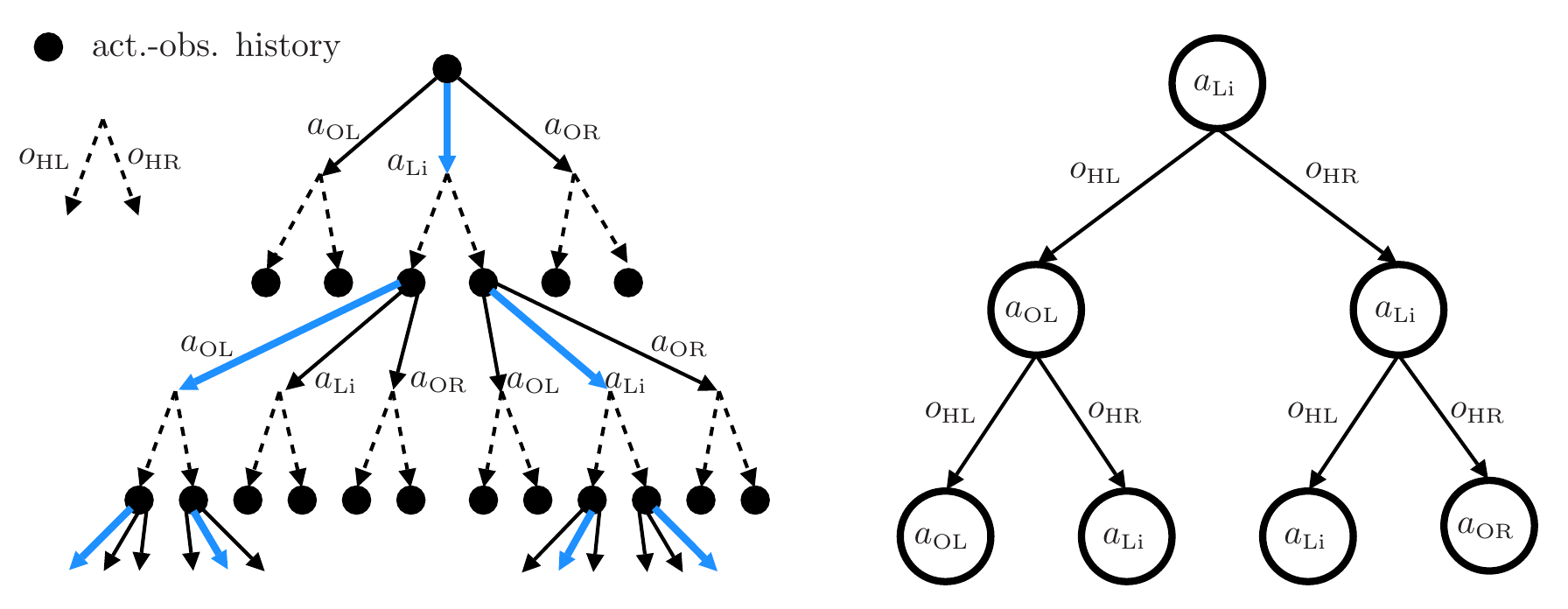
The policy tree is a plan whose branches use observations available to one agent. Training can construct that plan centrally without revealing other agents' observations at execution. For the deterministic policy shown, previous actions are inferable from its observation path; our stochastic-policy definition retains past actions explicitly.
3. Why centralized critics can train local actors
Assume separate parameter vectors and positive, continuously differentiable action probabilities. The score
depends only on the local history and sampled action. If the actor is recurrent, this derivative includes its dependence through the unrolled actor memory.
Derive the history-based policy gradient
First, differentiating the finite trajectory sum and using the likelihood-ratio identity gives
Environment factors have no parameter derivative; the product policy leaves agent 's own scores. Next, the conditional score mean is zero:
Rewards received before are measurable from . The tower property therefore removes their products with . The remaining return is , so
This is the finite-horizon counterpart of the policy-gradient theorem. Other agents' parameters are held fixed in this partial derivative.
Three critics, the same expected gradient
At fixed , define exact conditional team returns:
Conditional averages use the policy-induced joint law, not independently sampled histories, states, or actions. Values on zero-probability conditioning events are immaterial to these identities. Each critic predicts the same team return, using different information.
Write and . Because the score is measurable from either tuple, conditioning gives
The latter equalities apply the same tower argument to and then . A centralized critic can therefore weight a local actor's training gradient without becoming an input to its deployed decisions. Lyu et al. analyze the history-based relationship in Theorem 1 and the history-state relationship in Theorem 6; here the sums and conditionals are explicitly finite-horizon.
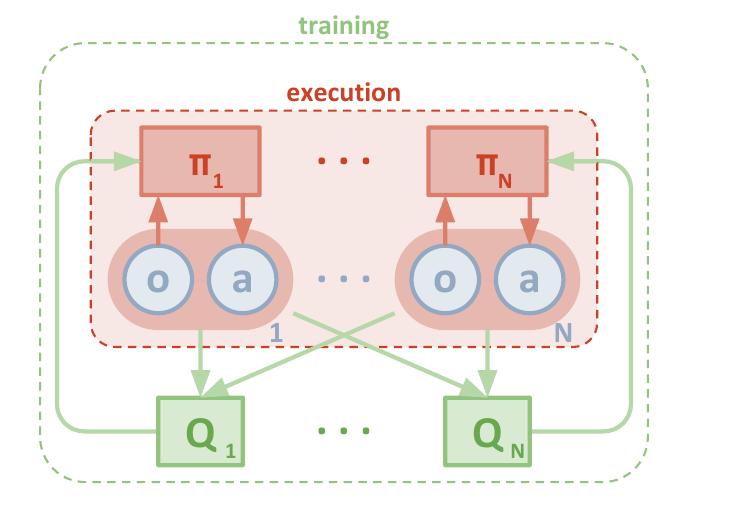
Lowe et al., Section 4.1 use decentralized actors with agent-specific centralized critics. Their method also permits different agent rewards; our derivation specializes to a shared team objective and retains histories when observations are insufficient. The figure's local observation inputs are not, by themselves, proof of Markov sufficiency.
The equality concerns exact on-policy conditional values. It does not imply that independently fitted critics produce identical finite-sample updates, or that concurrent gradient ascent reaches a global optimum. Part 2's counterfactual baseline can also be used with suitable history-aware critics; its cancellation still requires independence from the current own action conditional on the information held fixed.
4. More critic information need not reduce gradient variance
Fix one decision time and a policy . Let and define the random gradient contributions
All four use the same draw . The previous conditioning argument establishes
For example, the law of total covariance gives
Here expectations and covariances use , and means is positive semidefinite. Applying this identity to each nested conditioning yields
Conditioning replaces the return by its mean while retaining the information needed for the actor's score. Among these nested exact critics, the local critic averages over the most remaining randomness. This is Rao–Blackwellization: replacing a random estimator by its conditional mean cannot increase its covariance. The ordering agrees with Lyu et al.'s Theorem 2 and Theorem 7.
Check the inequality in Part 2's example
Reuse independent , and . For agent 1's logit score ,
Enumerating the four joint outcomes gives
These comparisons concern single-time contributions with exact critics and no added baselines. They do not rank fitted algorithms or estimators that use baselines. Nor do they compare sums whose contributions are correlated across time. In particular, they do not contradict Part 2's smaller COMA variance after subtracting a teammate-dependent baseline. A centralized critic may still be easier to fit accurately. Fitting error and sampling variance with exact critics are separate questions.
5. Why the physical state can be insufficient for a critic
A history-aware actor may behave differently after two histories that end in the same physical state. Its future behavior depends on what it remembers. Consequently alone need not determine the future distribution when that actor controls the environment.
To isolate the issue, consider even an exact state-only conditional predictor
The tuple does not generally determine . The tower property gives an expectation containing , not a product of two conditional means:
For vector scores, we take the covariance with the scalar return one coordinate at a time. This covariance need not be zero. A state-only Bellman recursion also needs a separate justification: a fitted temporal-difference fixed point need not equal the exact conditional mean of the return. Lyu et al., Sections 3.3 and 5 examine this distinction between state and history, and the resulting state-critic bias.
A two-decision counterexample
Agent 2 has only a no-op. Agent 1 initially observes a fair private bit , independent of the physical state. The state only records the decision time; it does not retain this irrelevant environmental signal. At ,
The physical transition does not depend on or . At , the current observation is constant. A fixed continuation actor remembers and draws
It receives and the episode ends. This is a valid Markov environment: the final reward depends only on the current action . Memory enters through the actor, not the environment. All nontrivial action probabilities are positive; only the first decision's parameters are varied.
The exact objective and first-decision history critic are
At , direct differentiation gives
Yet is independent of at this parameter point. Averaging over makes both state-only action values equal:
The score for parameter is . Thus the state-only critic gives
which misses both nonzero derivatives. These expectations use the explicit sampling law above. The example concerns substituting a state-only action-value predictor for the return. A state-dependent baseline subtracted from an otherwise valid return estimator can still cancel correctly; it is a different use of state information.
6. Retain actor memory, then remove training-only components
Using retains both the environment state and the information determining future actor behavior. It satisfies the exact conditional-gradient identity in Section 3. A compact alternative may retain the actors' actual controller memories instead of full histories.
For fixed recurrent controllers, suppose
The augmented variable has controlled Markov dynamics: generates the next state, observations and reward, and the displayed deterministic updates generate the next memories. It therefore suffices to evaluate these fixed controllers. A learned recurrent memory need not be an optimal belief state; this statement concerns evaluating the policy it actually implements.
Value-based CTDE makes a different separation. For example, QMIX trains a joint value of the form
When the mixer is nondecreasing in every utility, Part 2's coordinatewise argument applies at each fixed :
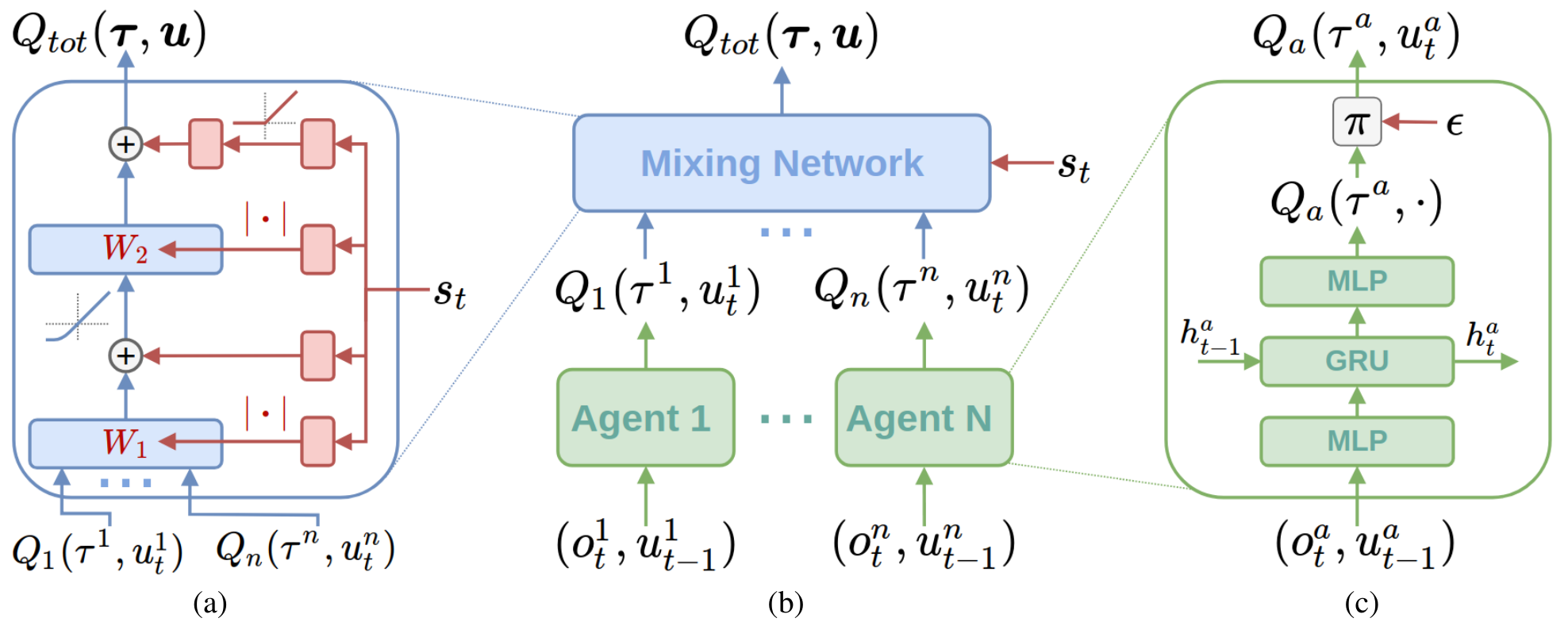
The mixer and its state-conditioned hypernetwork are training components. Each executing agent needs only its local utility network and memory. This guarantee maximizes the fitted joint value; it does not establish that the true optimal team value satisfies the monotonic restriction. See Rashid et al., Section 4.
7. A batch CTDE actor–critic procedure
We use independent fitting and actor-update episodes to separate critic estimation from gradient evaluation. This simplified on-policy procedure illustrates information access; it is not a reproduction of MADDPG, COMA, or QMIX.
For a frozen actor and fitting batch , regress complete reward-to-go targets:
At population level, unrestricted squared-error regression has the conditional-mean target . A restricted fitted network need not attain that target.
Input: Training simulator; local-history actors ; critic class; rounds ; batch sizes ; learning rates .
Output: Local actors and their local memory updates.
- for do
- Freeze .
- Collect independent batches and , executing every actor from its local history only.
- Compute on fitting episodes and fit by the displayed regression.
- for each agent do
- Set , treating the critic as fixed.
- Set .
- end for
- end for
- Export only the actors, local preprocessing, and local memory updates; omit the critic and training-only state inputs.
At a fixed round, condition on and the fitted critic. Independence of the gradient batch gives
An exact critic makes this gradient error zero. Splitting the episodes lets us evaluate the fitted critic conditionally, but its approximation and estimation errors remain. Data from a different behavior policy would additionally require an off-policy argument, and the simultaneous actor updates have no general global-convergence guarantee.
8. Check the deployed decision rule
For each actor, deployment must preserve the information restriction
Hold its local history fixed and change training-only state or teammates' histories: the actor's action distribution and local memory update must remain unchanged. Centralized features can still leak through preprocessing, shared runtime encoders, or a memory update that reads another agent's observations. Such a dependency violates the displayed restriction even if the final action head is labeled decentralized.
| Methodological choice | Available during training | Needed for one deployed decision |
|---|---|---|
| Centralized actor–critic | Joint histories/actions; optionally state and actor memories | That actor's local history or controller memory |
| VDN/QMIX | Team reward and joint utility loss; QMIX may use state in its mixer | Local utility network, local memory, local argmax |
| Explicit communication | The declared messaging protocol and its timing | Local information plus messages actually received before acting |
CTDE permits broader information for learning, not broader information for acting. History-aware conditional values preserve the expected gradient; access to the physical state alone does not establish that property. Part 4 uses this information distinction when developing multi-agent policy-gradient and actor–critic updates.
References
- Oliehoek, F. A., Spaan, M. T. J., and Vlassis, N. (2008). Optimal and Approximate Q-value Functions for Decentralized POMDPs. Journal of Artificial Intelligence Research, 32, 289–353. Sections 2.1–2.4 define the model, histories and policies; Figures 1–2 distinguish joint dynamics from local contingent plans.
- Lowe, R., Wu, Y., Tamar, A., Harb, J., Abbeel, P., and Mordatch, I. (2017). Multi-Agent Actor-Critic for Mixed Cooperative-Competitive Environments. NeurIPS. Section 4.1 and Figure 1 describe decentralized actors and centralized critics; the present note does not reproduce its deterministic/off-policy optimizer.
- Lyu, X., Baisero, A., Xiao, Y., Daley, B., and Amato, C. (2023). On Centralized Critics in Multi-Agent Reinforcement Learning. Journal of Artificial Intelligence Research, 77, 295–354. The journal article was published in 2023; this author-posted arXiv copy was uploaded in 2024. Sections 4–6 analyze history, state, and history-state critics.
- Rashid, T., Samvelyan, M., de Witt, C. S., Farquhar, G., Foerster, J., and Whiteson, S. (2018). QMIX: Monotonic Value Function Factorisation for Deep Multi-Agent Reinforcement Learning. ICML. Section 4 separates centralized value fitting from decentralized greedy utility selection.
The parity example, finite-horizon conditional-expectation derivations, and two-decision memory counterexample are worked constructions for this note. They are not new benchmark results or reproductions of the papers' experiments.